Electric heater type
This method involves heating water with a heater inside the can to generate steam. It is used in all ESTERI products.
| Benefits |
| They are often only available with a power connection, and there are many size variations, including floor-standing, tabletop, and horizontal models. |
| Disadvantages |
| Because water is heated inside the can to generate steam, it tends to take longer to heat up and have a longer total operating time. Furthermore, increasing the size requires a larger heater capacity, which is unsuitable due to the increased power consumption. |

Former steam type (steam supply type)
This method involves pumping a large amount of steam generated by an external boiler into the can body in one go.
| Benefits |
| Because pre-made steam is pumped into the can body, the heating rate is very fast and the operating time is shortened, allowing you to perform more operations per day. Furthermore, because it is large, it can handle large quantities. |
| Disadvantages |
| Boiler equipment is needed to produce steam, and extensive installation work is required. Furthermore, compared to electric heaters, the installation and running costs are higher. It consumes a lot of power and is not suitable for small-scale sterilization, and requires preparation time for steam generation Not immediately available) |


As mentioned above, an autoclave is a device that penetrates high-temperature steam into sterilized items to kill microorganisms.
To allow high-temperature steam to penetrate every corner, it is necessary to remove as much air as possible from inside the can or in the sterilized items and replace it with steam (to ensure it is filled with an infinitely saturated steam). Failure to meet these conditions, i.e., air remaining and insufficient steam, may result in poor sterilization.
Therefore, removing air from the can before the sterilization process 『air removal process』 is a very important step that determines the sterilization effect.
Problems if air remains
| Poor sterilization |
| Air has a lower heat transfer coefficient than steam, and the areas where air remains are not heated sufficiently. Air tends to accumulate, especially in places like the following: “In sterile bag, in porous material” ”In glass containers, in long pipes or tubes” This results in low temperature areas (cold spots) and a risk of microorganisms remaining. |
| Pressure abnormality |
| Air expands when heated. The air that cannot be removed during the air removal process will reach a pressure exceeding the saturated vapor pressure relative to the sterilization temperature, resulting in sterilization failure. Furthermore, safety devices that monitor the pressure will be activated, preventing the autoclave from functioning properly. |

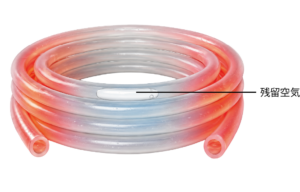
Main air venting methods
gravity displacement formula
A method in which air is pushed out by steam that continues to be generated by heating.

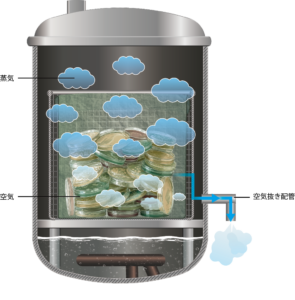
Pressurized pulse type
A method of repeatedly pressing and depressurizing air during temperature rise. Pressurizing the air promotes its expansion, and when the pressure is reduced, the air is released all at once, making it easier to remove air than gravity displacement.
| Benefits |
| Higher air removal performance compared to gravity displacement type |
| Disadvantages |
| The air removal performance is inferior to that with a vacuum pump |
| Main uses |
| Sterilization bags, tubes, metal tools, waste sterilization |
| Applicable models: EFN |


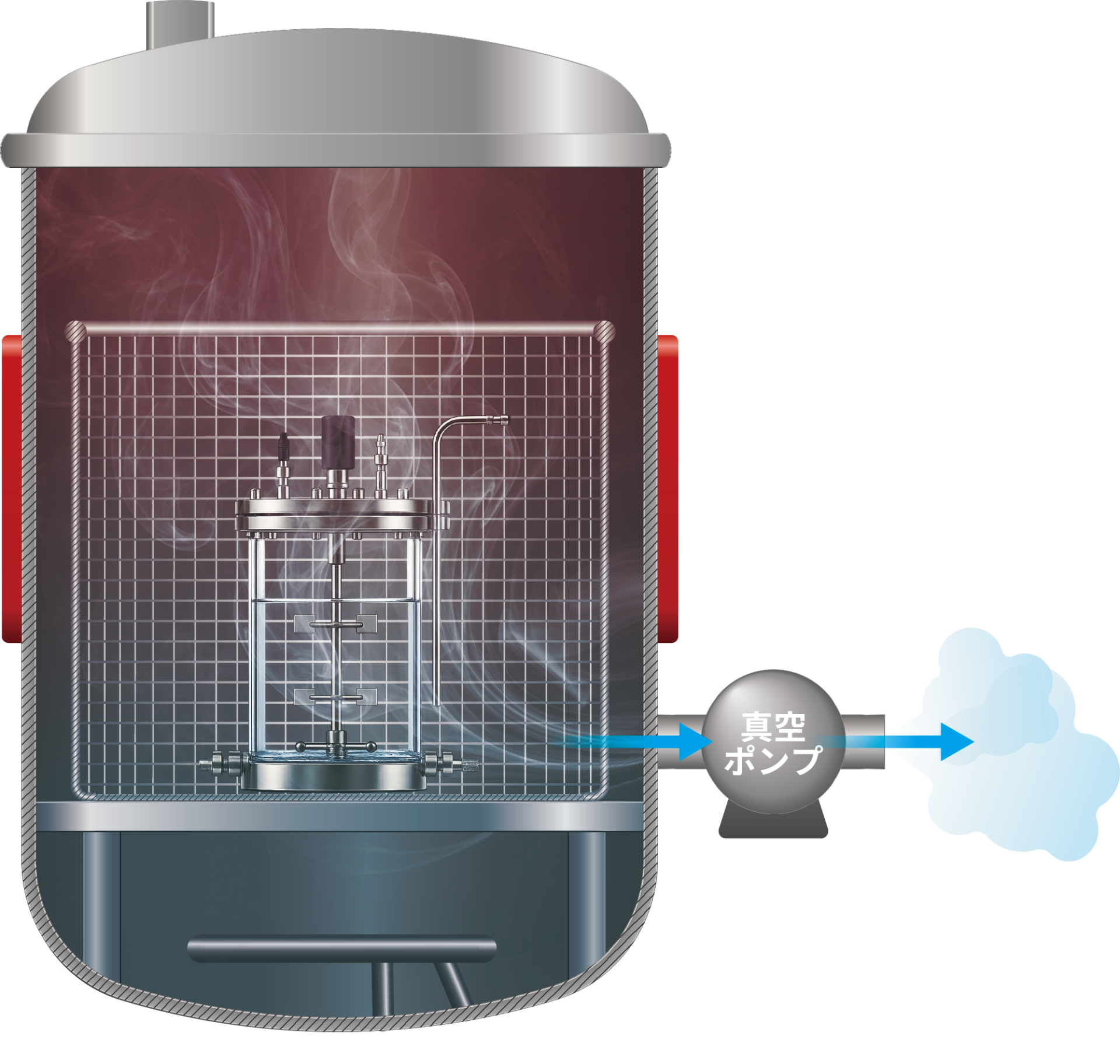
Pre-vacuum method
A method of drawing air from inside the can using a vacuum pump.
| Benefits |
| High air venting performance results in high vapor penetration and excellent reproducibility |
| Disadvantages |
| High price |
| Main uses |
| Sterile bags, other packaging materials, textiles, filters |
| Waste sterilization, medical equipment, animal husbandry materials |
| Applicable models: EFV |


Autoclaves are available in models with a drying function that automatically performs the drying process after sterilization.
By removing any remaining steam or condensed water from inside the can after the sterilization process is complete, it is possible to remove the sterilized items in a clean and dry state.
This reduces the risk of recontamination during storage and allows for a smooth transition to the next step.
In particular, for glassware, metalware, and equipment enclosed in sterile bags, sufficient drying plays a crucial role in maintaining quality and improving work efficiency.
Therefore, autoclaves with drying functions employ methods such as hot air drying and vacuum drying, depending on the structure of the sterilized items.
Hot air drying method
This method involves sending sterilized air through a wind pump to expel steam from inside the can.
| Benefits |
| Low cost due to simple drying function |
| Suitable for glassware and unpackagedware |
| Disadvantages |
| Slow temperature rise and long drying time |
| Packaged utensils and tubular items are difficult to dry |
| Main uses |
| Beaker Flask Charle |
| Applicable models: ESS-D |

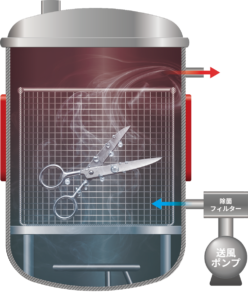
Vacuum drying method
This method involves forcibly extracting evaporated water using a vacuum pump.
| Benefits |
| Vacuuming reduces boiling point and allows for low-temperature drying, reducing damage to the sample |
| Forced discharge for good drying efficiency |
| Ideal for drying hard-to-dry tubes, fibers, and complex-shaped appliances |
| Disadvantages |
| High cost due to complex structure |
| Main uses |
| Packaging equipment, tubes, medical equipment, hollow equipment, textiles |
| Applicable models: EFV |

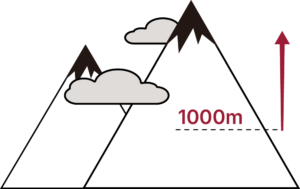
When using an autoclave at high altitudes (above 1000m), the following points should be noted:
The boiling point of water depends on atmospheric pressure. At an altitude of 0 m (1 atmosphere below), the boiling point was 100℃, but as the altitude increases and atmospheric pressure decreases, it drops below 100℃.
The pressure inside the can and outside the machine is approximately equal until the air release process in the autoclave.
At an altitude of 1500m and a boiling point of 95℃, the temperature inside the can will only rise to around 95℃.
Many autoclaves that use gravity displacement as their deaeration method incorporate a boiling point of 100℃ at 1 atmosphere into their operating program as part of the deaeration termination conditions. In other words, if the can body temperature remains below 100℃, the air venting will not be completed forever and the sterilization operation will not proceed.
Therefore, when using an autoclave at high altitude, it is necessary to use equipment that is properly conditioned according to the altitude of the installation location. ( ESTERI offers high altitude compatible specifications for each series.)
| Elevation (m) | Boiling point of water (℃) |
| 0 | 100.0 |
| 1,000 | 96.7 |
| 1,500 | 95.0 |
| 2,000 | 93.4 |
| 2,500 | 91.8 |
| 3,000 | 90.2 |
| 3,500 | 88.7 |
| 4,000 | 87.0 |