Precautions for use

To make ESTERI autoclaves safer and more effective to use
I've summarized the key points.

How to use sterile bags

There are two types of items commonly referred to as sterile bags. There are packaging materials (sterilization bags for instruments) used when sterilizing instruments and other items, and bags (sterilization bags for waste) used when sterilizing waste. Please note the following points when processing sterilized items.

Sterilization bags for instruments

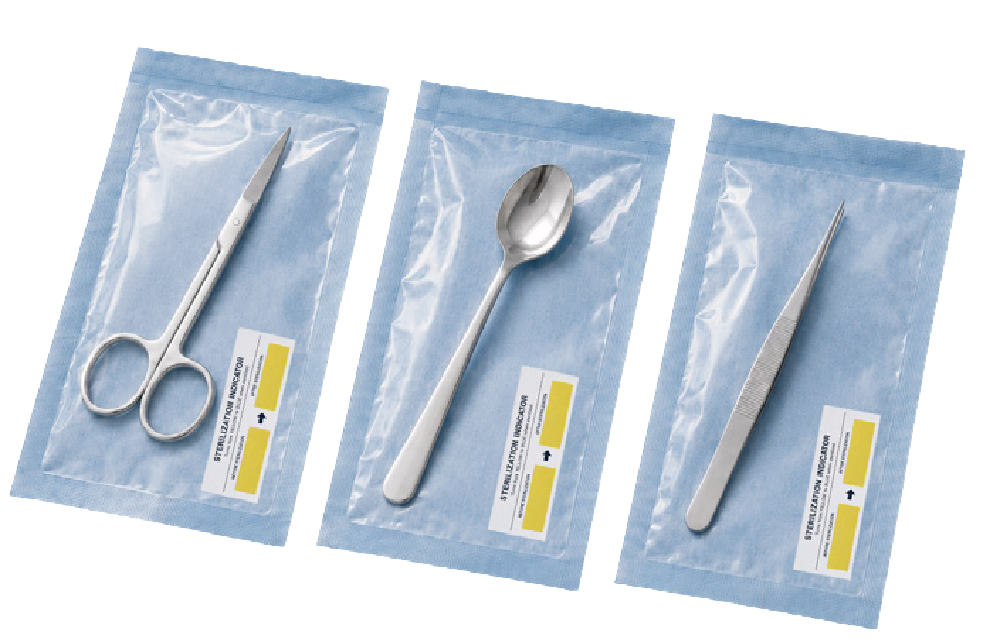
Packaging materials are used when sterilizing equipment (scissors, ladle, tweezers, filters, tubes, etc.) to prevent bacteria and viruses from getting on the equipment after sterilization. Typically packaged in individual packaging, the packaging material plays a role in keeping the equipment clean and protecting it from contamination until immediately before use.
When using sterile bags, sufficient steam penetration is required, and pre-vacuum venting is essential.

Recommended models: EFV Series

Use indicator―(sterilization indicator)

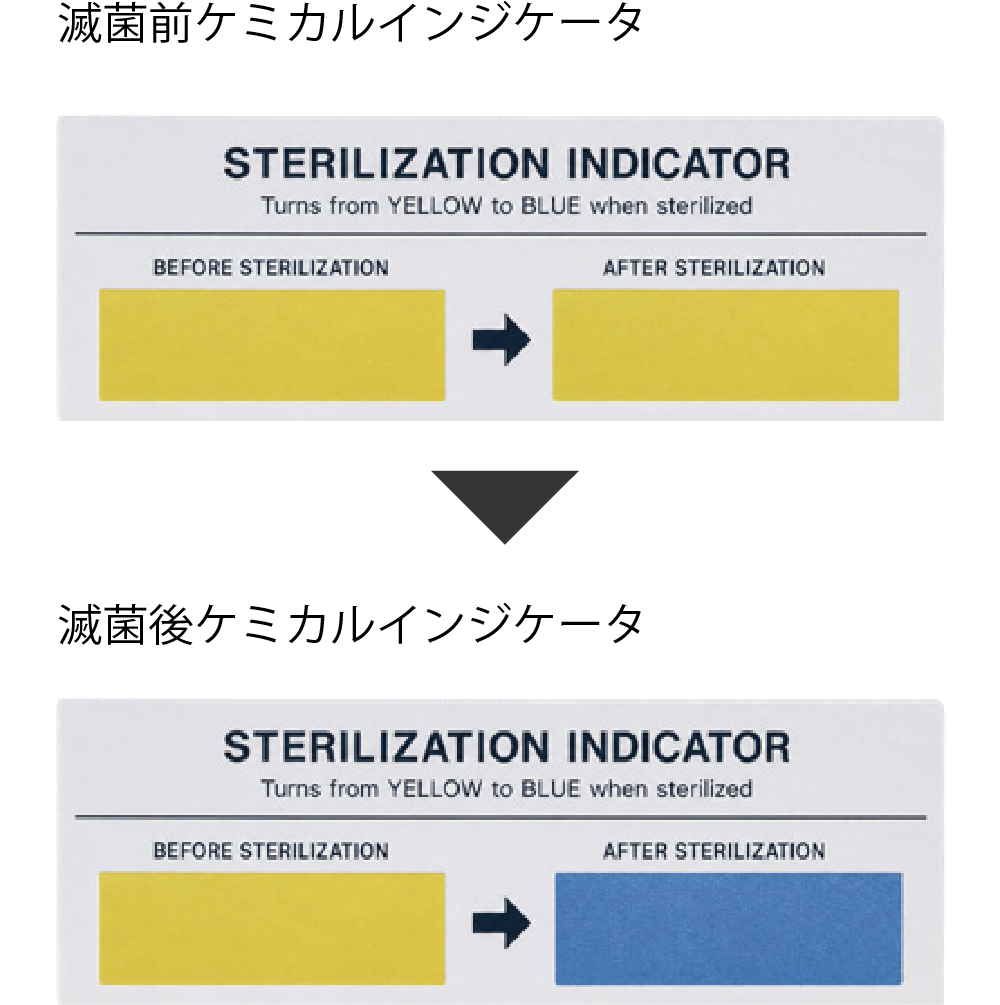
Sterile bags are packaged with a chemical indicator (CI) to ensure that heat and steam reach the inside each time.

Thorough drying

Moisture residue after sterilization can promote microbial contamination (recontamination). Sterilized equipment must be dried promptly.

Expiration date

Sterile bags have a deadline for the safe use of sterilized equipment, and this deadline must be set and managed according to the packaging material and packaging format.

Sterile bags for waste

Many sterilization bags (disposal sterilization bags) look like translucent plastic bags, but are made of heat-resistant resin that can withstand the high temperatures and pressures of an autoclave. When sterilizing waste, these sterilization bags are used to ensure that the waste is handled safely and in bulk, preventing it from scattering around or being touched by workers after sterilization. Always use this waste sterilization bag when processing heat-sensitive materials such as plastics (which can deform due to heat and not hold their shape).

Recommended models: All series

Always place it inside a wire mesh basket

When using sterile bags, always store them in an autoclave accessory or in a wire mesh basket made from genuine ESTERI accessories.
If you place the sterilization bag directly into the autoclave without using a wire mesh basket, it will block the piping inside the chamber, which could lead to an accident, so it is strictly prohibited.

Do not turn the sterilization bag over and remove it from the wire mesh basket

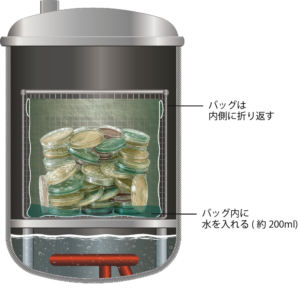
When placing the sterilization bag in the basket, please place the overhang of the bag inside the wire mesh basket.
If you fold the bag over the wire mesh basket, there is a risk that the folded edge of the bag may unintentionally block the piping inside the chamber.

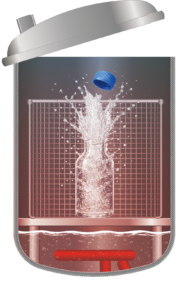
Fill a sterile bag with about 200ml of water

By generating steam even inside the sterilization bag, vapor permeability is increased, maximizing sterilization effectiveness.

Sterile bags do not close

Do not close the opening of the sterilization bag; keep it open. Closing the opening prevents the air inside from escaping (steam from penetrating), significantly reducing the sterilization effect.

Leak prevention

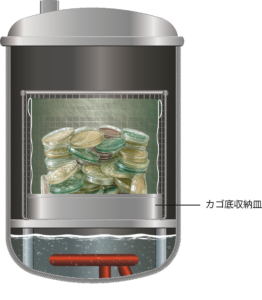
In case of a bag break, to prevent leakage, Kago bottom storage dish By installing this, the effort required to clean the inside of the can can be significantly reduced.

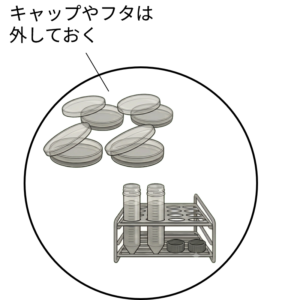
Remove the lid as much as possible

When using sealed containers such as deep-sink pipes or petri dishes, removing the lid improves vapor permeability and enhances sterilization.

Sterilizing bags should not be stacked

To prevent poor vapor penetration, do not stack baskets with sterile bags installed.
To ensure sufficient sterilization, please ensure that steam is distributed throughout the bag and its contents.

Regarding the use of sterile containers

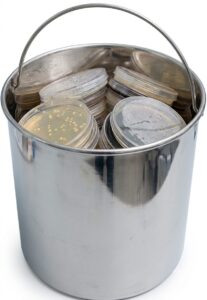
Autoclave sterilization uses stainless steel containers to make it easier to pack the contents together and handle and retrieve them, as well as to prevent contamination of the can body from spillage of culture medium and spills of liquid from cultured petri dishes. It can safely and efficiently process fine equipment, soil, waste, and more. Please note the following points when processing sterilized items.

Recommended models: All series (excluding some models)

Consider the container size

If there is no space at the top of the sterilization container, it will be difficult for the air to escape, and if the air does not escape properly, sterilization will not be performed correctly.
Tabletop autoclaves block the container with a lid on the can body, preventing air from escaping and resulting in poor sterilization.
Please check the table below for the conformity of each model.

Reference: Need and type of deflation (click to open page)

Model VN2121
(Φ210 ×210mm)
VN2727
(Φ270 ×270mm)
VN3630
(Φ360 ×300mm)
ESS-62 〇 〇 ×
ESS-96 〇 〇 〇
ESS-117 〇 〇 〇
ESS-62D 〇 〇 ×
ESS-96D 〇 〇 〇
ESS-117D 〇 〇 〇
EFN-62 〇 〇 ×
EFN-96 〇 〇 〇
EFN-117 〇 〇 〇
EFV-62 〇 〇 ×
EFV-96 〇 〇 〇
EFV-117 〇 〇 〇
ETV-50 〇 〇 ×
ETV-96 〇 〇 〇
ETV-118 〇 〇 〇
EAS-12 × × ×
ENS-12 × × ×
ENS-22 〇 × ×
ENS-37 〇 〇 ×
ENS-50 〇 〇 ×
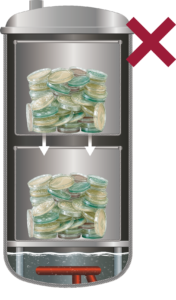
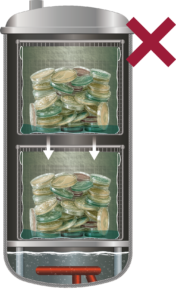
Do not stack or put on top of each other

When using the container, please use only one container.
If there is no space above the container for air to escape, the air will be trapped. If the air is not properly removed, sterilization will not be carried out correctly.

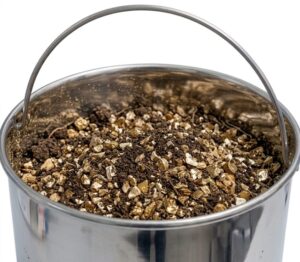
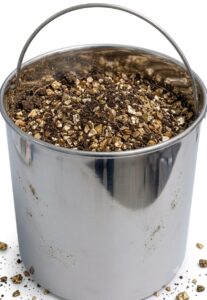
Keep soil and other materials lightly moist beforehand

Dry soil and vermiculite contain heat-resistant bacteria (spores), making them difficult to sterilize when left dry.
If possible, it is more effective to moisten it and leave it for a few hours ~ overnight before autoclaving.
Furthermore, we recommend processing small quantities in several batches rather than processing too many at once, and managing the temperature using a product temperature sensor.

Regarding the sterilization of instruments

When sterilizing instruments and other equipment, the details vary depending on what is being processed. Below are some representative examples.

Sterilization of equipment such as scissors, ladle, tweezers, filters, and tubes

For sterilization of scissors, ladle, tweezers, filters, and tubes, we recommend individual packaging in sterile bags.
The key points of the sterilization method are 『Sterile bags for instruments』 Please refer to the following items.

Reference: Need and type of deflation (click to open page)

Sterilization of containers such as beakers, flasks, and graduated cylinders

Containers used to store samples, culture media, etc., need to be carefully installed because they are difficult to remove air from.

Recommended equipment: All series

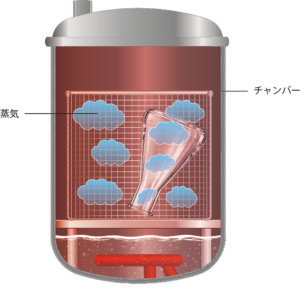
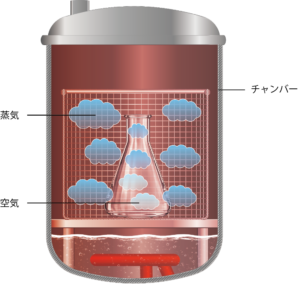
If it's an empty container, point it downwards

Because steam is lighter than air, it accumulates upwards.
If you turn your mouth upwards, cold air will be trapped inside, preventing steam from penetrating and causing poor sterilization.

Correct insertion method
Incorrect insertion
Consideration and selection of cooling process

Depending on the container material, the cooling process after sterilization is complete may require changes to the settings.

  • Glass: Do not open the exhaust valve after sterilization is complete. Sudden temperature changes may cause the glass to break.
  • Stainless steel: After sterilization is complete, you can immediately open the exhaust valve to release the steam. This can reduce the time per task.
Sterilization of resin products such as pipettes and trays

Common resin materials used in the RIKEN industry are:
Before autoclaving, please check the product specifications and labeling to ensure it is an autoclave-compatible product.

Recommended models: All series

Material name Heat resistance temperature (℃) Features
PP
Polypropylene
100~115 It is the most heat-resistant of all-purpose plastics and can withstand boiling water up to 100℃,
To prevent deterioration, continuous use of 120℃ or more is avoided. It is used for materials such as bottles.
PTFE
Fluorine resin
260 One of the highest heat resistance levels among all plastics. It is used for packing and sealing materials.
PC
Polycarbonate
110~120 It is highly amorphous and can be used in environments of 100℃ or more while maintaining transparency.
It is used for materials such as cases, racks, and bottles.
PE
Polyethylene
70 〜 90
(HDPE)
50 〜 70
(LDPE)
Low density (LDPE) is sensitive to heat and deforms into a mushy substance even at low temperatures. Even at high density (HDPE), the limit is less than 100℃. It is used in materials such as bottles and droppers.
PS
Polystyrene
60~80 It is quite weak to heat and can withstand boiling water, but it easily melts and deforms when heated by oil. It is used in materials such as deep-sedimentation tubes and culture flasks.
PET
Polyethylene terephthalate
60 〜 70
(Not strengthened)
150 〜 200
(GF reinforcement)
Unreinforced plastic bottles deform to less than 100℃, but industrial grades reinforced with glass fiber (GF) (such as switch components) instantly increase their heat resistance. It is used as a material for PET tubes and reagent bottles.
PVC
Polyvinyl chloride
55 〜 65
(hard)
When heat is added, it begins to soften from a relatively low temperature. Furthermore, if high temperatures continue, hydrogen chloride gas is generated, causing deterioration (discoloration and embrittlement). It is used as a material for tube and water-based products.

Regarding the sterilization of liquids

When sterilizing liquids (culture media, water, reagents, etc.) using an autoclave (high-pressure steam sterilizer), improper handling can lead to serious accidents such as burns from liquid spurt (outburst) or container rupture. For safe use, please note the following:

Prevention of sudden boils (toputsu)

A boiling point is a phenomenon in which a liquid at a high temperature above its boiling point (100℃) boils rapidly due to a small trigger such as vibration, causing it to violently blow out into the surrounding area. To prevent a sudden boil, please pay attention to the following points:

- For the cooling process after sterilization is complete, the exhaust valve will not be opened and the product will be cooled naturally.
- When opening the lid, make sure it is below 80℃.
- Select the model equipped with the safety device "Futa Interlock System."

Models equipped with: EAS-12 , ESS , ESS-D , EFN , EFV Series

Do not sterilize in a sealed state

If a container is sealed, the pressure inside the container may rise and it may not be able to withstand the pressure and burst.
Do not sterilize glassware that has creases or scratches.
Furthermore, sealing the container makes it difficult for air to escape, which can lead to poor sterilization.
For safe use, please note the following:

  • Screw-in bottles such as medium bottles are loosened by one or more turns from the point where they are fully closed
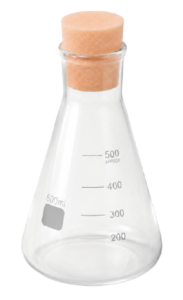
  • For flasks, no rubber stoppers are used, but breathable cotton or sponge stoppers are used
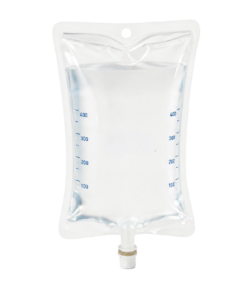
  • For sterilizing sealed items such as infusion bags, the cooling process is equipped with a pressure function Retort sterilizer Select

Regarding processing volume

In autoclave processing, it is important to be able to distribute the steam generated in the chamber to the sterilized material.
Please note that increasing the processing volume may hinder steam penetration and cause sterilization defects.

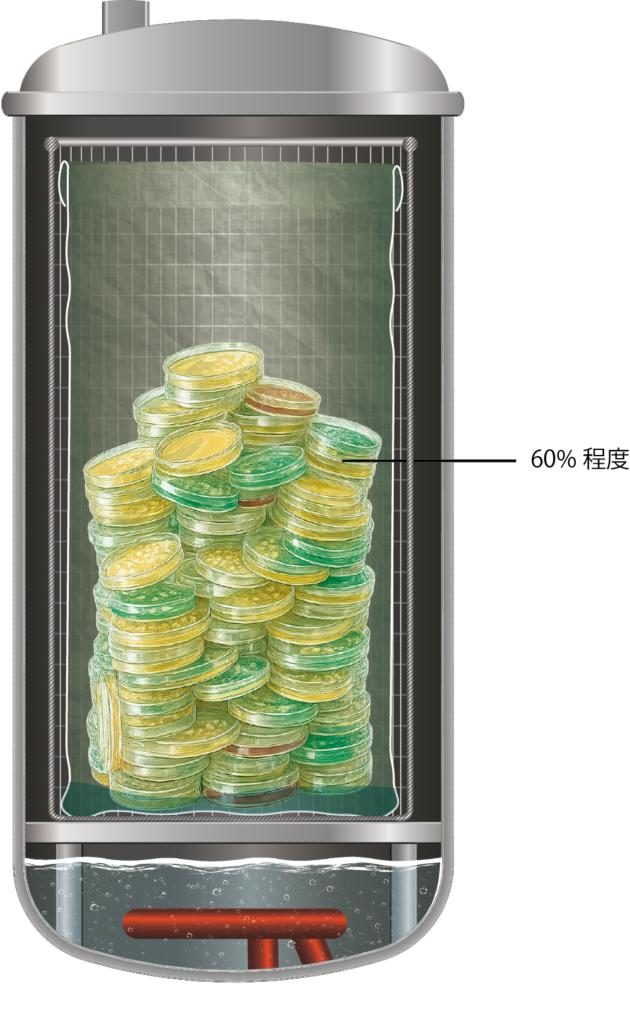
  • The processing volume should be approximately 60% of the chamber volume.
  • Sterilized materials should not be stacked as much as possible.

Regarding sterilization time

Sterilization is not just about applying temperature to the object.
『By continuously adding the right temperature 』for the right amount of time『, you can only achieve a sufficient sterilization effect.

Consider sterilization time lag (delay time)

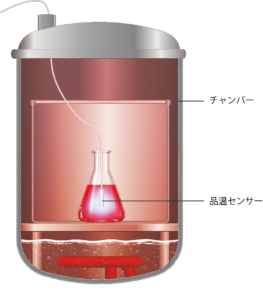
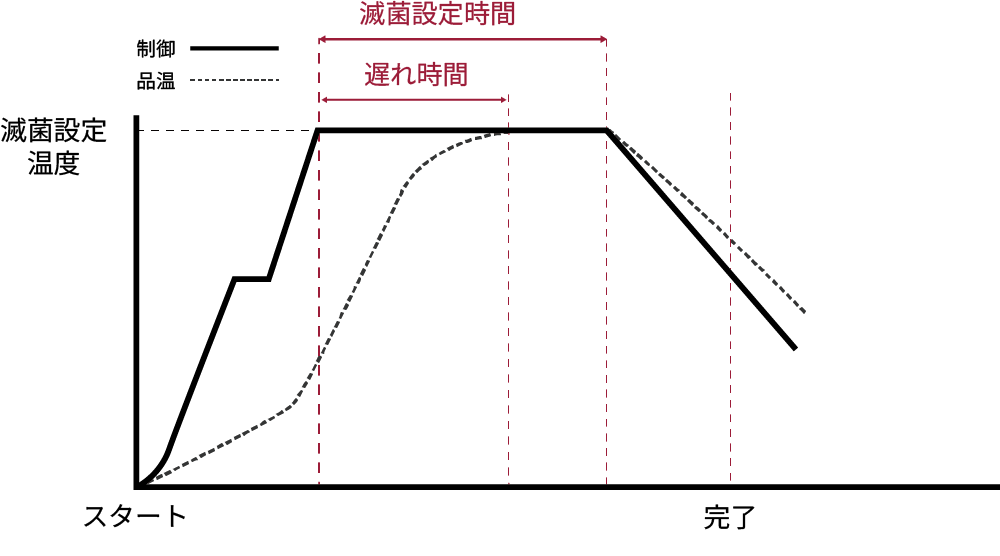
To ensure sterilization, it is important to understand the "sterilization time lag (delay time)." The temperature displayed on the autoclave is the temperature inside the can, and the actual temperature of the sterilized product is reached with a delay. Furthermore, this delay time varies depending on the amount and arrangement of ingredients, as well as the state of the liquid.
Therefore, it is important to check the temperature of the sterilized items themselves, rather than judging them based solely on the displayed temperature.

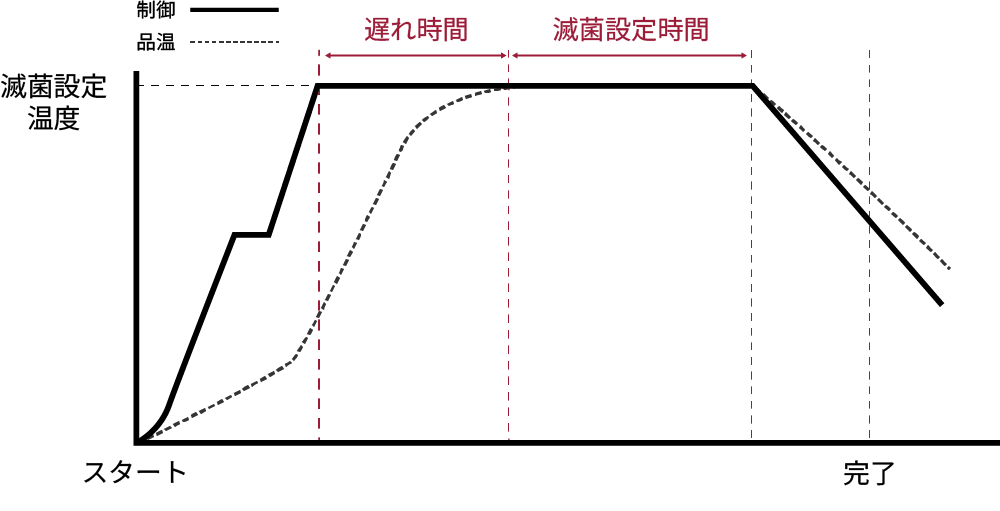
The impact of sterilization time lag (top graph) and operation when using a product temperature sensor (bottom graph)

Optional Product temperature sensor By adding this, you can accurately determine when the object has reached the set temperature. You can also use the sterilization timer's start function from that point.
This allows for reliable sterilization without uneven or insufficient processing.

Models with additional options: ESS , ESS-D , EFN , ENV series